Showing posts with label japanese art. Show all posts

Monday, November 5, 2012

The Japanese Aesthetics of Hipsterism

In her essay on Japanese aesthetics, Yuriko Saito argues that the marked appreciation for the asymmetrical, the unfinished, and the damaged stems from philosophical attitudes that deal with the process of coming to terms with the unpalatable realities of life—specifically its impermanence and general messiness. (1) Essentially, the Japanese preference for the care-worn and the subtly decaying is part and parcel of an acceptance of the fluidity and intransigence that characterize life on earth. Though this is all well and good, Saito fails to fully explore one of the most interesting aspects of this phenomenon: the trend toward the deliberate production of well-worn and damaged objects that originated at least in the Heian period (794-1185) and became fairly common from the fifteenth century on.

Saito notes the trend, but for the most part attributes it to a general preference for contrast that is intertwined with the philosophical currents previously mentioned. The tea master Murata Shukô (1423-1502) is said to have reframed an elegant hanging scroll that was given to him by the shogun using rustic materials; another tea master deliberately destroyed one of the handles of a perfectly symmetrical vase; another was ridiculed for repeatedly destroying the perfection of highly-prized objects. (2) In each of these cases, Saito argues that these acts bespeak a specific philosophical stance and furthermore that they are only valuable acts because the objects are capable of being perfect, but are not:
It is important to note that this aesthetic celebration of the imperfect and the insufficient presupposes not only the yearning for but also the attainability of the optimum condition, understood as a shiny mirror, a gorgeous and properly framed scroll, a meticulously maintained garden, and a perfectly formed vase. A cloudy mirror Sei Shônagon appreciates is not a cheap or defective product; it was shiny once. A wild garden exalted by her did not result from the owner not being able to afford maintaining it; rather, it was a calculated neglect (emphasis added). Falling cherry blossoms are aesthetically superior to those in full bloom precisely because they had previously achieved the stage of full blossom. Chipped and cracked tea wares could be repaired. The impoverished looking scroll does not imply an inability to choose opulent materials; it is a production of conscious design. Similarly, a flower vase missing one handle is not a result of failed creation. (3)
But it is precisely this deliberate intervention into the aesthetic forms of various objects, which picked up speed in the Momoyama and Edo periods (1576-1868), that is the crux of the matter. In the seventeenth century, for example, the tendency to prize objects that had been accidentally broken and then repaired was transformed into an affluent fad where objects were deliberately broken and repaired using gold and silver rivulets along the cracks. (400 years later a number of these admittedly exquisite objects found their way into an exhibition at the Freer and Sackler galleries in DC—Moonlight and Clouds: Silver and Gold in the Arts of Japan.) What had once been an aesthetic grounded in simplicity became evidential of a considerable level of affluence.

And for me that is the really interesting process. Because, it is a process that happens all the time all over the place. Hell, we see it right now in dieting fads and hipster culture—the ironic appreciation of something that is suboptimal, which ultimately transforms into a major marker of wealth, power, and influence. The ancient, medieval, and early-modern Japanese had what I would consider to be a fairly clear-cut hipster culture. It was so clear-cut that it even came under the same kind of scrutiny that hipster culture comes under today. In the eighteenth century, the Confucian scholar Dazai Shundai (1680-1747) called the wealthy tea ceremony practitioners out for aping the culture of impoverished, arguing that while the rich might find it amusing to copy the poor, the poor would never find it amusing because their condition was not something that they merely dabbled in. (4) In many ways, though not in all ways, the tea ceremony (and many other arts that stemmed from the same aesthetic roots) was an ironic enjoyment of something that the partakers would never have enjoyed in its original context. In other words, it was "hipster."

And for reasons I cannot explain (but probably because I am something of a hipster myself), it delights me no end to discover that hipster culture has—in a weird way—always been around.

Notes:
1) Saito, Yuriko. "The Japanese Aesthetics of Imperfection and Insufficiency." The Journal of Aesthetics and Art Criticism 55, no. 4 (Autumn 1997): 377-385.
2) Ibid., 378.
3) Ibid., 380.
4) Quoted in ibid., 381

Creative Commons License
This work is licensed under a Creative Commons Attribution-NonCommercial-ShareAlike 3.0 Unported License.

Saturday, November 5, 2011

What do you mean "grotesque"?

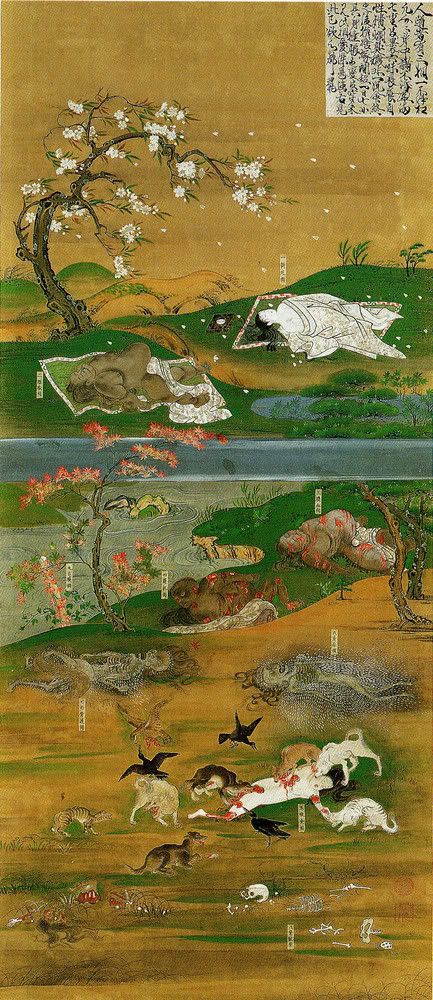
When it comes to studying pre-modern art—or pre-modern anything, for that matter—you have to be extremely careful when it comes to the application of modern theoretical concepts. Of late, this caution has been drilled into my head repeatedly, as I have been reading books and essays about depictions of the supernatural and/or grotesque in Japanese art, literature, folklore, and religious texts, and it is not always clear that the phrase “grotesque” is one that can be accurately applied. Most recently, having read two articles on the subject of Japanese images of decomposing corpses (kusôzu, lit. “images of the nine stages”), I have spent a good deal of time pondering whether or not such images can be called grotesque.

Decomposing corpse images were created from the thirteenth through nineteenth centuries in Japan. They depict the nine stages of corporeal decomposition that take place after death: recent death, bloating, rupture, putrefaction, consumption by animals, discoloration, dissolution of the flesh, fragmentation of the bones, and complete disintegration. They appear in various formats—including hanging scrolls, handscrolls, and woodblock printed books—and all images feature women, a fact that has caused some scholars to suggest that decomposing corpse images—and stories that center on the decomposition of female corpses—at the very least reveal a gendered gaze and quite possibly express the inherent misogyny of medieval Japanese Buddhist thought. (1) The two articles that I read on the subject did not dwell on this aspect of the argument however.

Gail Chin, in her essay on the topic, argues that the images actually exhibit a multiplicity of meanings. She focuses her study on how the images were intended to educate viewers of both sexes about the “frailty of human existence” and the “repulsive nature of the human body” by means of utilizing a female body as emblematic of the non-duality of Buddhist doctrine. (2) Through the process of decomposition, the female body is shown to metaphorically transcend flesh and achieve a stage of nothingness (enlightenment). The implication, Chin asserts, is that if a woman—one of the most impure and repugnant incarnations in the Buddhist cosmology—can become enlightened, so can anyone. (3)

Kanda Fusae, by contrast, argues that the images have different functions in different eras and that their relative levels of adherence to the doctrinally established progressions, as well as changes in their stylistic elements, provide clues as to what those functions were. From the early medieval to the Edo period, Kanda identifies four basic functions to which decomposing corpse images were applied: object of meditative contemplation, tool of didactic practice, meritorious offering on behalf of a deceased loved one, and handbook for the moral education of young women. (4)

While both authors are primarily focused on the relationship of the images to Buddhist doctrinal theory and temporal context, they both employ the term “grotesque” to describe the images. While Chin uses the term only once in passing, (5) Kanda repeatedly refers to the depictions of decomposing corpses as grotesque. Moreover, she associates grotesqueness with explicitness. As the images become less and less faithful to biological exactness over time, Kanda deems them less grotesque. (6) Neither Chin nor Kanda ever really fully articulate what they mean by “grotesque,” but their use of the term seems to me potentially legitimate, even though the grotesque can often refer to an entire aesthetic discourse that contemporary producers of decomposing corpse images would have known nothing about.

The meaning of the word grotesque today has diverged considerably from its original meaning, and an exploration of its etymological origins lies well outside the scope of this essay. (7) By the nineteenth century, a number of different interpretations of the grotesque proliferated and the much-studied theories of John Ruskin are among the most important of those. (8) In contrast to Walter Bagehot, who viewed the grotesque as something that arose involuntarily in nature, (9) Ruskin considered the grotesque to be a deliberate product of artistic volition that could be either noble or ignoble depending upon the moral character of the artist in question. The greatest example of the grotesque, in Ruskin's view, arose from the serious confrontation of the unexplained horrors of the world. For Ruskin, the honest contemplation and rendering of those terrors that man cannot comprehend had the potential to ennoble. They were, in a sense, didactic.

It's certainly tempting to think about Japanese images of decomposing corpses in the Ruskinian context. Both Chin and Kanda argue for a "moralizing" dimension to the works, and the confrontation with a blatant depiction of death could certainly be classified as a confrontation with an incomprehensible horror—particularly in Japan, where death has always been viewed as a terrible defilement and source of taboo. Nevertheless, one particular aspect of Ruskin's philosophy makes it a bad fit for pre-modern Japanese art, and that is Ruskin's belief that artistic volition can be determined via stylistic analysis. For Ruskin, the intention of the artist is writ large in the visual elements of the art object. (10) In the pre-modern Japanese context, where artists very often worked under a director at the behest of a patron, there is no question of artistic volition. Consequently, a theory of the grotesque that eschews issues of artistic agency is preferable.

Noël Carroll, who I cited in my previous entry and for whose theories about grotesque art I have a fair degree of simpatico, defines the grotesque along very useful structural lines. His definition is based upon the supposition that the grotesque is comprised of things that violate our sense of the natural and ontological order of things. This includes fusion figures (composites), instances of disproportion, formlessness, and gigantism. Carroll's structural view of the grotesque applies only to animate beings; while a building or an idea can be metaphorically grotesque, they are not "structurally" grotesque. (11) In this conceptualization, the grotesque actually stands apart from moral concerns. It can be aligned with moral, amoral, or immoral concerns on a case-by-case basis.

This concept of the grotesque seems like a better fit for Japanese images of decomposing corpses. The experience of viewing a human body in varying stages of decay is unsettling, to say the least. The corpse represents a break with our natural expectation of human appearance; namely, that the human being will be alive. As decomposition progresses, the corpse becomes disproportionate and finally formless. The human becomes thoroughly inhuman.

However, one might argue that the process of decomposition, though unsettling, is not biologically abnormal. (The abnormality would come if the corpse sat up and started calling for brains, or otherwise behaved in an un-corpse-like manner.) One might further argue that within the context of medieval Japanese Buddhist ritual practice, the corpse actually constituted a fully natural object. Or, on the other hand, one might argue that the corpse, as a traditional object of horror, revulsion, and taboo would always have carried an unnatural—offending—connotation.

The real question, it seems to me, is not whether or not Japanese images of decomposing corpses can be called grotesque. The question is whether or not they should called grotesque. And on that point, the jury is still out.

Notes:
1) Tonomura Hitomi is one scholar who explores this possibility, albeit briefly and in the wider context of medieval Japanese literature as a whole. See “Black Hair and Red Trousers: Gendering the Flesh in Medieval Japan,” The American Historical Review 99, no. 1 (February 1994): 145.
2) The concept of non-duality holds that all things in the universe—whether animate or inanimate, in pursuit of Buddhist knowledge or no—contain the Buddha nature and therefore have the potential to achieve enlightenment. In non-duality, things usually considered to be diametrically opposed to one another (for example passion for earthly pleasures and the renunciation of such) are understood to actually be one and the same.
3) Gail Chin, “The Gender of Buddhist Truth: The Female Corpse in a Group of Japanese Paintings,” Japanese Journal of Religious Studies 25, no. 3-4 (1998): 277-317.
4) Kanda Fusae, “Behind the Sensationalism: Images of a Decaying Corpse in Japanese Buddhist Art,” The Art Bulletin 87, no. 1 (March 2005): 24-49.
5) Chin, 308.
6) Kanda, 37-38, 41.
7) For a thorough history of the grotesque see David Summers, “The Archaeology of the Modern Grotesque,” in Modern Art and the Grotesque, ed. Frances S. Connelly (Cambridge: Cambridge University Press, 2003): 20-46, or chapter 1 of Wolfgang Kayser’s The Grotesque in Art and Literature, trans. Ulrich Weisstein (Bloomington: Indiana University Press, 1963): 19-28.
8) Ruskin's ideas about the grotesque are found scattered throughout his considerable output, but two of the most valuable sources for his thoughts on the subject are found in "Grotesque Renaissance," in The Stones of Venice, Volume 3 of 1853, and "Of the True Ideal: Thirdly, Grotesque," in Modern Painters, Volume 3, Part 4 of 1856. Both are available online through Project Gutenberg and Google Books, respectively. My reading of Ruskin derives entirely from these essays.
9) Walter Bagehot, "Wordsworth, Tennyson, and Browning; or, Pure, Ornate, and Grotesque Art in English Poetry," in The Collected Works of Walter Bagehot Volume 2, ed. Norman St. John-Stevas (Cambridge: Harvard University Press, 1965): 353.
10) Ruskin explores artistic volition via stylistic analysis at length in his evaluation of two griffin sculptures from ancient Rome and the Lombard-Gothic period. See "Of the True Ideal: Thirdly, Grotesque," 105-112.
11) Noël Carroll, "The Grotesque Today: Preliminary Notes Toward a Taxonomy," in Modern Art and the Grotesque, ed. Frances S. Connelly (Cambridge: Cambridge University Press, 2003): 291-312.

Creative Commons License
This work is licensed under a Creative Commons Attribution-NonCommercial-ShareAlike 3.0 Unported License.

Wednesday, November 2, 2011

The Gendered Perception of Violence.

Recently, I was wasting time rather than pushing ahead with my comprehensive exam reading (much like I am now) by watching a series of specials aired by the cable channel Bravo on the 100 most frightening film scenes. I justified this expenditure of time by telling myself it would provide an interesting counterpoint for the readings I was doing. Color me shocked when this turned out to actually be true.

I had gotten almost all of the way through the countdown when I came upon entry #11 - Miike Takashi's ground-breaking Audition (1999) - and I noticed a very curious phenomenon. The commentators on the movie, almost all of them men, were strikingly disturbed by this film. Rob Zombie (yes, the Rob Zombie who made House of 1000 Corpses [2003] and The Devil's Rejects [2005]) called it one of the few films that actually creeped him out, and John Landis (director of 1981's An American Werewolf in London) actually said that it was "too real" and wondered what the filmmakers were thinking when they made it.(1)

I found this reaction kind of peculiar, particularly coming as it was from two giants of the horror film genre. No other film selected had produced that kind of response from its reviewers. #50 on the list, Wes Craven's Last House on the Left (1972)— a film with a similar level of violence—had generated praise. It was referred to as "taboo-breaking," "a political statement about the nature" of violence, and something that "pushed the envelope." (2) This in spite of, or perhaps because of, its graphic depiction of death by disembowelment. The commentators were horrified by this film, but not profoundly disturbed by it in the way that they clearly were with Audition. So why should that be? Well, the answer may lie in the object of the film's violence and in a gendered perception of violence as whole.

Audition is a film about a mild-mannered, middle-aged widower. His son and his friends have been urging him to remarry for years, as they want him to have someone to take care of him, but he's resisted up until now. In order to find a wife he participates in a fake audition—staged by a film producer friend—where around forty women are brought in under the false pretense of auditioning for a part in a film. The man picks one of the women to date and (if all goes well) to marry. However, the women he picks is completely and utterly out of her mind, and she eventually breaks into his house, ties him up, and tortures him (the torture including, but not limited to, activation of pain points with acupuncture needles and amputation of the feet with piano wire).

The really interesting thing about the way the male commentators talk about this movie is the fact that they classify the main character as a completely likable guy. This is, I think, the key to why they feel so profoundly uncomfortable with this particular brand of violence. They identify with him, and they experience the violence done to him in a way that is uncomfortable to a degree that seeing a young woman stabbed to death is not uncomfortable.

This argument is the basis of an essay on early-medieval Japanese art by the scholar Ikeda Shinobu entitled "Images of Women in Battle Scenes: 'Sexually' Imprinted Bodies." (3) In the essay Ikeda suggests that the predominance of female victims in the famous handscroll "Burning of the Sanjo Palace" in the Illustrated Tale of the Heiji Disturbance (Heiji monogatari emaki), coupled with the depiction of the warriors in the scroll with barbaric, almost comic features, indicates that this handscroll was probably produced by and for a courtier audience. She further suggests that the female victims, some of whom are shown en dishabille, serve as focuses of sexual excitement for the viewers.

While I don't accept the second-half of this argument (for reasons that I will explain below), I do somewhat accept the first-half of it. The notion that a Kamakura period courtier would not have enjoyed visualizing someone who looked an awful lot like himself be trampled and beaten is a fairly sound one. Even the most emphatic horror fans of the modern age have shown themselves to dislike violence perpetrated against the "I-guy" and to only embrace it when there is significant payoff in the end (as in Hostel where the main character takes bloody revenge on his tormenter). Identification with film characters is what makes the horror genre so hard to deal with, and—if I may suggest it—what makes the horror genre hard for many women to appreciate. In the horror film, women are nearly-always the object of lingering violence, which invokes a strange kind of fascination if you can imagine it happening to someone else but evinces utter revulsion if you are made to feel it happening to you.

My belief that psychological impulses operating in the modern period also operated in the pre-modern period is a tricky one to hold, I admit. On the one hand, I feel it is important to ground all historical inquiries firmly within an appropriate context that takes into account as much of the reality of the era as we can reconstruct. On the other hand, I also feel that the human animal hasn't really evolved all that much in the last thousand years. Consequently, even as I struggle for the all powerful holy grail of "proper historicity," I'm haunted by a sense that plus ça change, plus c'est la même chose.

This is actually why I cannot accept the second premise of Ikeda's argument. I don't read horror connoisseurs' appreciation of violence as tied to sexual excitement in any period. A number of films certainly do play upon the horrific qualities of sexual violence—A Clockwork Orange (1971), The Evil Dead (1981), Meatball Machine (2005), Slither (2006), etc.—but these sequences are almost invariably read as fearsomely grotesque rather than titillating. (4) There's no reason to assume that things would have been different at the early-medieval Japanese court. The argument that the representation of horror often involves a gendered gaze, and that violations of the standard trope of male visualization of violence against the female are specifically transgressive and unsettling, is a strong one. But a gendered gaze is not ipso facto a sexualized one.

Nevertheless, the gendered gaze provides a framework in which violence (often sexual in nature) can more easily be done to women as it is invariably more acceptable. And as a good friend of mine recently pointed out, this acceptability of violence trickles out into other genres as well. Just consider what the reaction to a female vampire protagonist stalking a male high school student would be. We all love the oh-so-epic-and-true romance of Edward and Bella, but we'd be shocked and horrified by Edwina and Beau. In fact, we have quite a lengthy record of being complacent in response to male-female aggression in the mainstream while at the same time being censorious of female-male aggression. The noted self-defense specialist Gavin de Becker has pointed out that films reinforce this narrative in countless scenarios. (5) Benjamin Braddock of 1967's The Graduate is a charming oaf, whose annoying persistence ultimately gets him the girl. Evelyn of 1971's Play Misty for Me is a psychopathic bitch, whose terrifying persistence ultimately gets her killed.

The reality of the stalker experience is that both of the above scenarios (male-agressor-female-victim and female-agressor-male-victim) (6) are the same, but the cultural perception of them—filtered through a very gendered lens—results in extremely different media portrayals.

The mild-mannered, middle-aged widower of Audition is the nicest guy in the world according to the male commentators who squirm in response to his protracted torture. But actually, he's not the nicest guy in the world. He's a man who cynically used a fake audition to orchestrate a no-strings-attached, no-risk-involved trip to the meat market. It doesn't mean that he deserved to be tortured, but it does tell us a lot about the way we as a society still think of the role of cause-and-effect in violent acts. If he'd been a mild-mannered, middle-aged widow I suspect that the narrative of what happened to he[r] (and how [s]he participated in bringing it on [her]self) would be very, very different.

---
Notes:
1) Commentary on Audition can be viewed here from the 7:58 mark. Viewer discretion is advised.
2) Commentary on Last House on the Left can be viewed here from the 1:10 mark. Viewer discretion is advised.
3) Ikeda Shinobu, "Images of Women in Battle Scenes: 'Sexually' Imprinted Bodies," in Gender and Power in the Japanese Visual Field, ed. Joshua S. Mostow et al (Honolulu: University of Hawai'i Press, 2003): 35-48.
4) For a thought-provoking breakdown of the different "species" of the grotesque, see Noel Carroll, “The Grotesque Today: Preliminary Notes Toward a Taxonomy,” in Modern Art and the Grotesque, ed. Frances S. Connelly (Cambridge: Cambridge University Press, 2003): 291-312.
5) Gavin de Becker, The Gift of Fear (New York: Dell, 1999): 236-37.
6) Admittedly, this argument relies on a hetero-normative binary example. While I recognize that the issue of non-cisgendered violence is equally serious in this day and age, it is outside the scope of this essay.

Creative Commons License
This work is licensed under a Creative Commons Attribution-NonCommercial-ShareAlike 3.0 Unported License.